
Newport News County Court Records After Arrest
A Newport News arrest typically moves from police contact to booking at Newport News City Jail, then to magistrate review, prosecutor review, and court filing. NNSO says arrested people are taken to the City Jail for booking and usually appear before the magistrate for probable cause and bail bond hearings. Once the case reaches the courts, the record is maintained through Virginia's court systems and the Newport News court clerks rather than through the jail roster.
The custody side and the court side answer different questions. The Newport News County jail inmate records path is for current local custody, booking status, jail contact, and roster fallbacks. The court records after a jail arrest path is for formal charges, hearing dates, dispositions, court costs, continuances, appeal or transfer history, and whether a charge remains pending. Booking photos are a separate records issue handled on the Newport News County jail mugshots page.
Process flow: Arrest to booking to magistrate review to prosecutor charging decision to General District Court or Circuit Court case record.
Find Newport News Court Records After Arrest
Start with the local facts that identify the person and event: name spelling, arrest date, charge wording, incident number, arrest number, or warrant charge. The Newport News Police Daily Arrests dashboard can help with that first pass because it lists arrest number, date and time arrested, block address, charge, name, demographics, incident number, precinct, and arresting officer. It is not the court record, but it can narrow the search before the Virginia court portals are used.
- Search the jail roster or Daily Arrests dashboard to confirm the name, arrest date, and charge language.
- Search Newport News General District Court for misdemeanors and felony preliminary hearings.
- Search Newport News Circuit Court for felony indictments, felony trials, appeals, and serious criminal matters.
- Open the case and read each charge, hearing date, status entry, disposition, costs, appeal, or transfer note.
- If an older or non-online file is needed, contact the correct clerk because Virginia Self-Help warns that not all circuit records are available in the same online system.
The city court information page links readers to Virginia's case information systems. The Newport News Circuit Court case information page names Clerk Angela F. Reason and routes users to the state portal.
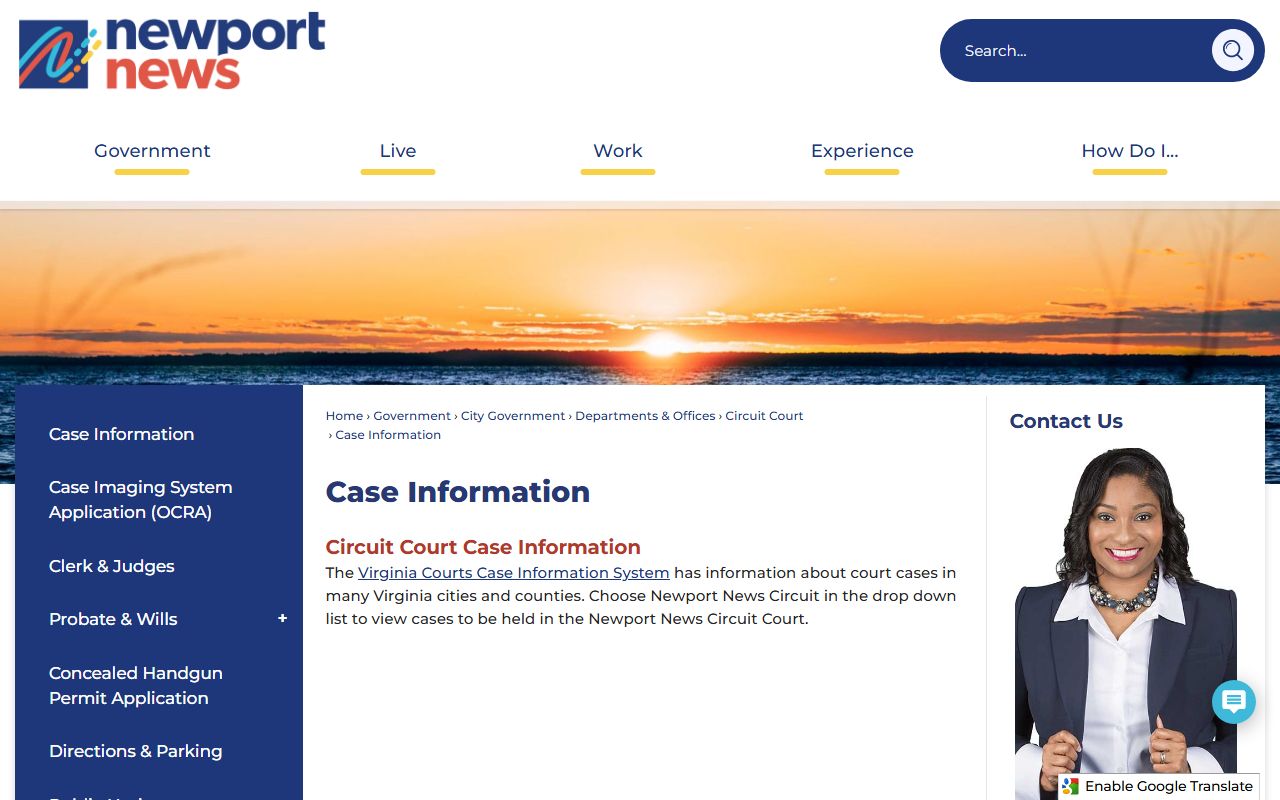
That city page is useful when a person needs the local court route rather than the jail roster or police dashboard.
Newport News County Court Lookup Fields
Virginia splits criminal case search by court type. General District Court handles traffic cases, misdemeanors, and felony preliminary hearings. Circuit Court has broad trial authority and hears serious felony matters, felony indictments, and appeals from lower courts. Juvenile and Domestic Relations District Court is different: Virginia Self-Help states that no online case information is available for JDR cases because of confidentiality.
| Portal | Field Label | Type | Required | Notes |
|---|---|---|---|---|
| Circuit Court Case Information | Court or locality | Dropdown/list | Yes | Choose Newport News Circuit Court; statewide circuit search is not available through this route. |
| Circuit Court Case Information | Name | Text | One search option | Use defendant name when the case number is not known. |
| Circuit Court Case Information | Case number | Text | One search option | Exact case number narrows the result. |
| Circuit Court Case Information | Hearing date | Date | One search option | Useful when a name spelling is uncertain. |
| General District Court Case Information | Court or locality | Dropdown/list | Yes | Choose Newport News criminal or traffic as appropriate. |
| General District Court Case Information | Name, case number, or hearing date | Web form | One search path | Payment instructions describe name entry as last, first, middle if any. |
| Statewide criminal/traffic search | Name or case criteria | Web form | Varies | Covers general district and select circuit criminal/traffic information, but payments cannot be made there. |
Charges Filed After Arrest
The first charge wording after a Newport News County arrest may be an officer's arrest or warrant description. Court records after a jail arrest use formal court entries and charging language that can change as the case moves. The Commonwealth's Attorney may file, amend, reduce, dismiss, nolle prosequi, or pursue different charges from the booking description. A felony may begin in General District Court for preliminary hearing and later move to Circuit Court by indictment or other transfer route.
| Document Type | Who Uses It | Common Role | Newport News Search Note |
|---|---|---|---|
| Complaint or warrant-based charging paper | Officer, complainant, magistrate, or prosecutor path depending on the case | Starts or supports many lower-court criminal matters after arrest. | Look for the charge and case status in General District Court first when the matter is a misdemeanor or felony preliminary hearing. |
| Information | Prosecutor | A prosecutor-filed charging document in criminal practice. | Not every online docket labels the charging paper this way, so rely on the case type, charge, and status fields shown by the court. |
| Indictment | Grand jury and prosecutor | Formal felony charge in Circuit Court. | Search Circuit Court when a felony has moved beyond preliminary hearing or has been directly indicted. |
Newport News Charge Status
Charge status is the part of the court record that tells whether the accusation is still open, moved, changed, or resolved. A pending charge is not a conviction. A dismissed charge is not the same as an acquittal. Nolle prosequi means the prosecutor declines to proceed at that time. Certified or waived to grand jury means a felony is moving from district court toward circuit court review.
| Status | What It Means | Why It Matters |
|---|---|---|
| Pending | The charge is open and has not reached final disposition. | Expect future hearing dates or continuances. |
| Continued | The hearing moved to another date. | The case remains open unless another status says otherwise. |
| Certified or waived to grand jury | A felony moved from district court toward circuit court. | Search Circuit Court for the next stage. |
| Indictment | A grand jury returned a formal felony charge. | The Circuit Court docket becomes central. |
| Amended or reduced | The charge changed from the original wording. | Do not rely only on the jail booking charge. |
| Dismissed | The charge ended without conviction. | Eligibility for expungement or sealing depends on Virginia law and the exact outcome. |
| Nolle prosequi | The prosecutor declined to proceed at that time. | It is a prosecutor action, not a guilty finding. |
| Guilty or convicted | The court entered guilt by plea or finding. | Sentencing, costs, probation, jail, or VADOC custody may follow. |
Bond After Newport News Arrest
Bond begins at the magistrate or court stage, not in the police dashboard. NNSO states that after arrest and booking, the person appears before a judicial officer, usually the magistrate, for probable cause and bail bond hearings. The Newport News Magistrate's Office page also warns that magistrates may not disclose pending criminal-charge information. For outstanding warrants and summonses it routes users to NNPD at 757-928-4100, and for jail inmates it routes users to NNSO at 757-926-3984.
| Bond Type | How It Works | Record Clue |
|---|---|---|
| Personal recognizance or unsecured release | Release on promise and court conditions without paying secured money up front. | The case remains active even if the person leaves jail. |
| Secured or cash bond | Money or security must be posted before release. | Jail custody can continue until the bond is posted and no other hold blocks release. |
| Surety bond | A licensed bail bondsman or surety posts bond for a fee or collateral. | NNSO does not recommend bondsmen. |
| No bond | Release is not authorized at that stage. | Only a later court order may change the hold. |
| Hold or detainer | Another agency, warrant, probation/parole matter, DOC, federal, or ICE notice affects release. | Posting local bond may not end custody. |
Warrants Before Jail Arrest
An outstanding warrant can be the reason a person is arrested, booked, and then appears in court records after a jail arrest. Newport News has an Active Warrants dashboard that displays name, physical-description fields, date of birth, age, sex, race, issue date, and warrant charge. The city also has an active-warrants page organized by the first letter of the last name.
NNSO says a person may surrender at the City Jail 24/7 at the first-floor receptionist window. A warrant surrender should include photo ID if available. A delayed-sentence surrender should include photo ID and court sentencing paperwork. No one should ignore a warrant. The safer record path is to contact an attorney, the correct court clerk, or the listed law-enforcement number and arrange surrender or appearance in a controlled way.
Newport News Prosecutor Records
Virginia uses the title Commonwealth's Attorney for the local prosecutor. The Newport News Commonwealth's Attorney prosecutes criminal cases that occur in the City of Newport News for the Commonwealth. The elected Commonwealth's Attorney identified in the research is Shannon M. Jones. The office is separate from the police, sheriff, magistrate, and court clerk. That separation explains why a jail roster, police arrest dashboard, prosecutor decision, and court docket can describe the same event in different terms.
Newport News Commonwealth's Attorney
2501 Washington Avenue, 6th Floor
Newport News, VA 23607
757-926-7443
Prosecutes criminal cases that occur in Newport News.
Charges Versus Convictions
Court records after a Newport News County arrest should be read by stage. An arrest, warrant, complaint, or indictment is an accusation or formal charge. A conviction is a court outcome after a guilty plea, finding of guilt, or verdict. The sheriff's inmate-search page makes the same point from the custody side by warning that current incarceration does not necessarily mean conviction.
| Question | Charge | Conviction |
|---|---|---|
| Stage | Accusation or formal court filing. | Final guilt finding or plea accepted by the court. |
| Proof level | May rest on probable cause or grand jury action. | Requires the legal standard for guilt. |
| Where it appears | Jail records, police arrest data, warrants, and court dockets may all show charge language. | Court disposition and sentencing entries show the outcome. |
| Why it changes | Prosecutor or court may amend, reduce, dismiss, or indict differently. | Later appeal, probation, or sentencing actions can still affect the case. |
Sealed and Expunged Records
Virginia public access law starts with openness, but criminal records can have limits. Virginia FOIA presumes public records are open unless an exemption applies. Virginia Code provisions on criminal-history records, expungement, and sealing create a separate path for records that may be restricted after eligible outcomes. The research date also matters because Virginia's sealing law has timing and eligibility rules that changed on July 1, 2026.
| Issue | Sealed | Expunged |
|---|---|---|
| Public view | Public access is restricted under the sealing process. | Eligible police or court records are removed from ordinary public access through an expungement order. |
| Virginia sources | Va. Code Section 19.2-392.12 | Va. Code Section 19.2-392.2 |
| Eligibility | Depends on charge, outcome, waiting period, and statutory category. | Depends on the case outcome and court order. |
| Practical step | Use the court order with agencies that maintain the record. | Use the court order with the originating police, court, or jail record holder. |
Restricted Newport News Court Records
Not every record connected to an arrest is public online. Juvenile and Domestic Relations case information is not available online because of confidentiality. Juvenile secure detention is separate from the adult jail roster. Ongoing investigations, protected victim information, sealed records, expunged records, and some criminal-history database material may be withheld or redacted. Virginia Code Section 9.1-126 helps separate public court records, wanted lists, and original chronological records from state criminal-history dissemination rules.
The same arrest can require several channels: jail roster for custody, Daily Arrests for recent police arrest data, active warrants for warrant status, court portals for charges and dispositions, NNSO FOIA for jail booking records, NNPD Records Unit for police reports, VADOC for sentenced state custody, BOP for sentenced federal custody, ICE ODLS for immigration detention, and VINELink for notifications.